Generation of Corrective Impulse Response for Spatial Reconstruction
2025
Acoutics system
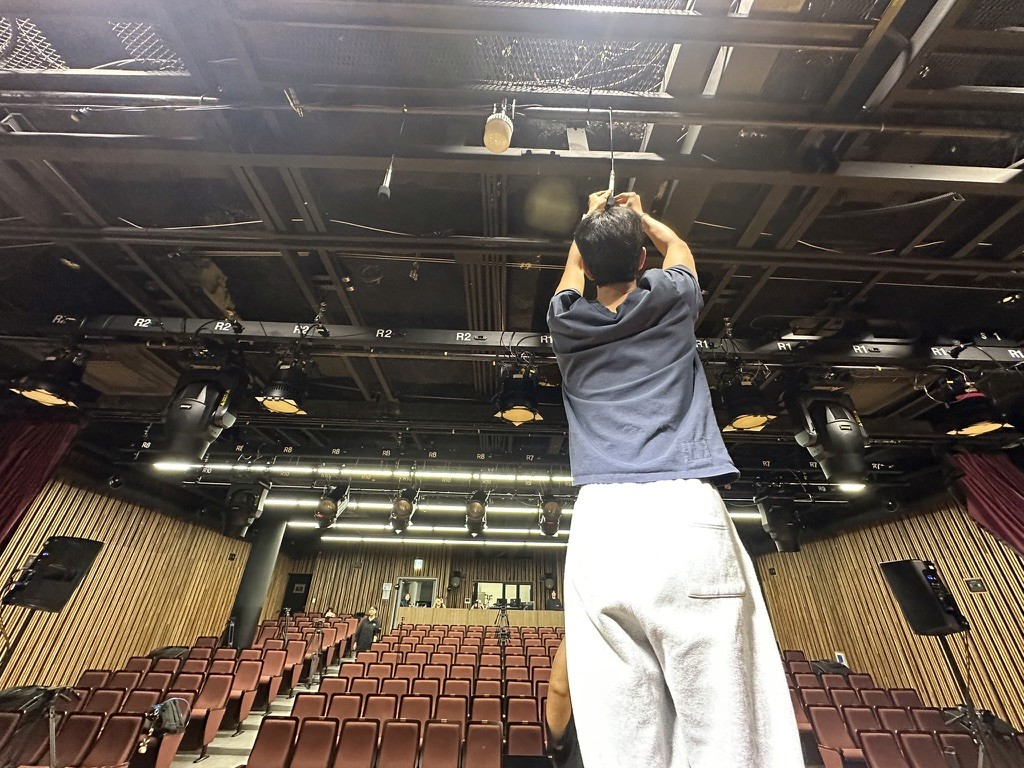
I began by rethinking “Reverb.” In live sound we usually hear algorithmic or sampled reverbs, not the room itself, so I set out to recreate a real hall response in my college’s venue. I built a real-time room-morphing pipeline.
This project investigates how spatial perception can be made more consistent across different performance spaces by generating a corrective impulse response based on quantitative analysis of both the target and current venues. I designed a Python-based pipeline to analyze impulse responses, compute a frequency-domain corrective filter, and generate FIR filters while controlling early and late reflections. The generated corrective IRs were then implemented into a Max/MSP-based real-time convolution system, allowing independent correction per speaker channel during live performance.
Verification focused on early reflection coherence (0–40 ms), achieving a correlation coefficient of 1.0, indicating a near-perceptual match with the target hall.
This project reframes performance sound not as the application of effects, but as a measurable and correctable system, extending field audio practice into a structured research problem.



Get this for FREE!